|
Malaysia is known as being a mega-diverse country in terms of its biodiversity. It has a vast range of flora and fauna, and even many of the limestone caves are home to a wide range of fauna. In temperate caves, especially in Europe, it is not common to see much cave fauna. Most of the fauna is restricted to the threshold zones, where invertebrates such as insects, and possibly small mammals may be seen. Deep inside the cave there may be a few bats. In contrast, tropical caves of south east Asia often abound with life.
This cave fauna ranges from tiny microscopic organisms right through to elephants. However not all these creatures are troglobites (cave dwellers). Some are troglophiles (animals which are found in the caves but can also live outside), and others are trogloxenes (enter caves occasionally). Cave visitors include people and elephants.
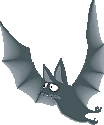
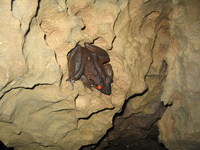
Studies on the cave fauna began at the beginning of the 20th century. The cave food chain is quite complex but everything ultimately depends on the bats for survival. There is no sunlight in caves, so no photosynthesis can take place therefore plants cannot grow. Bats are the only creatures which regularly go outside the cave to feed. There are two types of bats, the insect eaters and the fruit bats. They leave the cave at night to feed on insects, fruits, pollen, and it is their resulting guano or excreta which deposited in the cave supports the whole food chain, from the smallest bugs through to the cave dwelling snake.
The guano is home and food to countless creatures, including flies, beetles, bugs, millipedes, springtails, cockroaches, worms, mites and moths. These animals are in turn fed upon by the cave crickets, centipedes, scorpions, whip scorpions and spiders. And these provide food for small mammals, frogs and toads. Animal carcasses, especially those of bats, are scavenged almost immediately, and soon nothing remains except for the bare skeleton. The bats and the cave swiftlets have parasites such as mite, chiggers, ticks, fleas and flies. Particularly noticeable in Deer Cave, Mulu are the Hairy Earwigs which live on the Naked Bats, feeding on oils produced by the bats to protect their skin.
The water dwellers such as debris feeders, larvae and flat worms are eaten by snails, fish, and crabs. Catfish can be seen in some cave rivers, and there are various species of white crab, especially in Mulu and Bidi. Sometimes terrapins and turtles can be seen in caves.
At the top of this whole food chain is the cave snake. The cave racer (Elaphe taeniura) is the only snake which is adapted to spend its whole life in a cave, feeding exclusively on bats and swiftlets.
Many of the species show a high degree of endemism. Some invertebrates such as the trapdoor spider of the Liphistius species may be endemic to just one cave, for example Liphistius batuensis is only found in Batu Caves and nowhere else.
© Liz Price [abridged from Acta Carsologica, 2004, Vol 33, No 1, 311-317.]
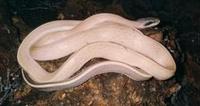
cave racer, Orthriophis taeniurus
(Elaphe taeniura) |
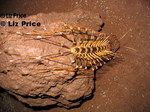
long legged centipede, Thereuopoda |
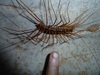
Thereuopoda in a Pahang cave |
Many foreign scientists have come to Malaysia to study cave fauna, in particular the invertebrates, geckos, bats and guano. Much research has been done on bats. Chasen published the first faunal list of bats in 1940 and recorded 84 species. The latest list by Simmons in 2005 lists 125 species (ref ANWARALI KHAN et al, 2008). Of course only a small percentage of these are cave dwellers.
Invertebrate studies have recently been done on the long-legged centipede (Thereuopoda sp.), cave cockroaches, Liphistius spiders and millipedes. New species of invertebrates are commonly found and documented in scientific journals.
Dark Cave at Batu Caves, Selangor, is the best researched cave in Malaysia. Studies began in the 1880's by Ridley, and the first fauna survey was done in the 1920's. But despite the comprehensive research work done over the last century, it is still easy to find new species. For instance, in 2003 Dittmar et al in just 3 hours found 14 new records for this cave, 3 of which are supposedly undescribed. A lot of work has been done on snails in Sabah by SCHILTHUIZEN et al, many of the papers can be found on the internet.
Excluding bats, the only species of cave fauna which seem to be protected by law are Liphistius spiders, and the Niah cave gecko, (Crytodactylus cavernicolus) . This is found in caves in Niah and Mulu.
Archaeology:
In addition to the modern day cave fauna, many archaeological studies have been done on bones found at cave sites, revealing a wide range of mammal bones. Probably the best studied cave is Niah Cave in Sarawak. Bones have been found some small mammals right up to large ungulates such as rhino and tapir. Interestingly although the Bornean Pygmy Elephant has only recently been described as a new subspecies, there are no finds of any Asian elephants in digs at Niah or Madai caves.
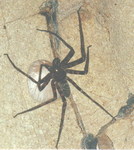
spider with egg sac |
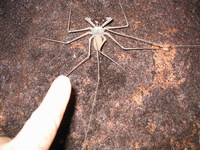
whip spider |
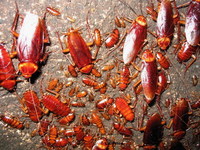
cockroaches in Dark Cave |
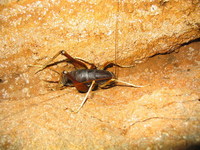
cricket |
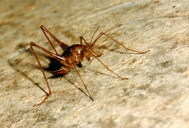
cricket |
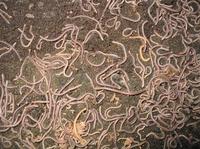
millipedes feeding on bat guano |
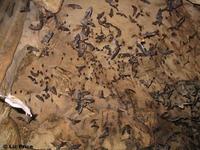
bats |
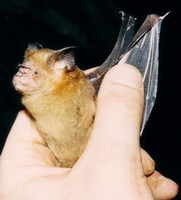
Hipposideros larvatus bat (photo by Julia Altmann) |
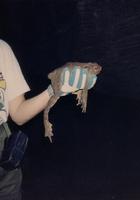
Phrynoidis aspera (old name Bufo asper) toad |
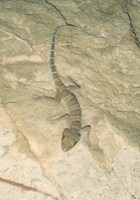
Perlis gecko (Cyrtodactylus spp.) |
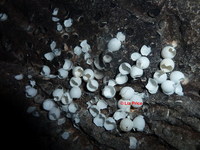
gecko eggs |
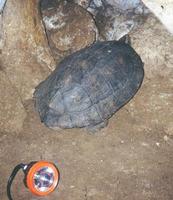
terrapin in a cave in Perlis |
See more photos of geckos on my blog. Since 2008 researchers led by Lee Grismer have been researching geckos in karst areas in Malaysia and have found seven new karst-adapted species of Rock Geckos (Grismer et al 2014).
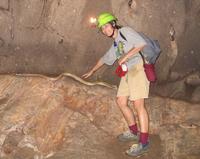
cave racer |
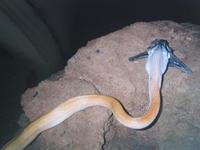
racer eating a bat |
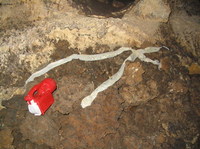
skin shed by cave racer, 220 cm long |
Troglobites or troglophiles or trogloxenes ?
Troglobite - a creature that lives permanently underground beyond the daylight zone. Troglophile - an animal that enters beyond the daylight zone of a cave intentionally and habitually and spends part of its life in the cave, such as bats and swiftlets. Trogloxenes are creatures that will enter caves on occasions but do not use the caves for permanent habitation e.g. pythons, porcupine, goats, and humans.
A feral cat used to live in Dark Cave at Batu Caves and was thought to be a troglobite as it was always seen far from the entrance in the totally dark zone. Several rats live in Dark Cave, again in total darkness, and have successfully bred.
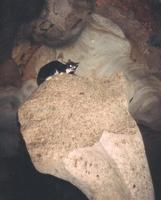
cat in Dark Cave |
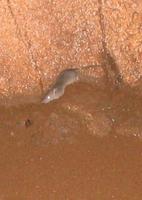
rat in Dark Cave |
frog, an accidental visitor, Limnonectes blythii |

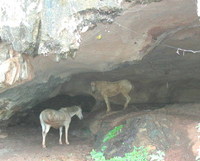
cave horses! |
|
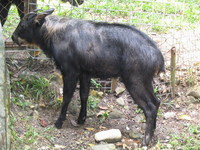
The serow is found on limestone hills, and although very shy, the droppings can often be seen outside cave entrances. (picture from zoo)
© Liz Price 2004 - 2014
Page last updated 9 Feb 2014 |
|